Amazon FBA Fees 2026: Every Fee, With Real Numbers
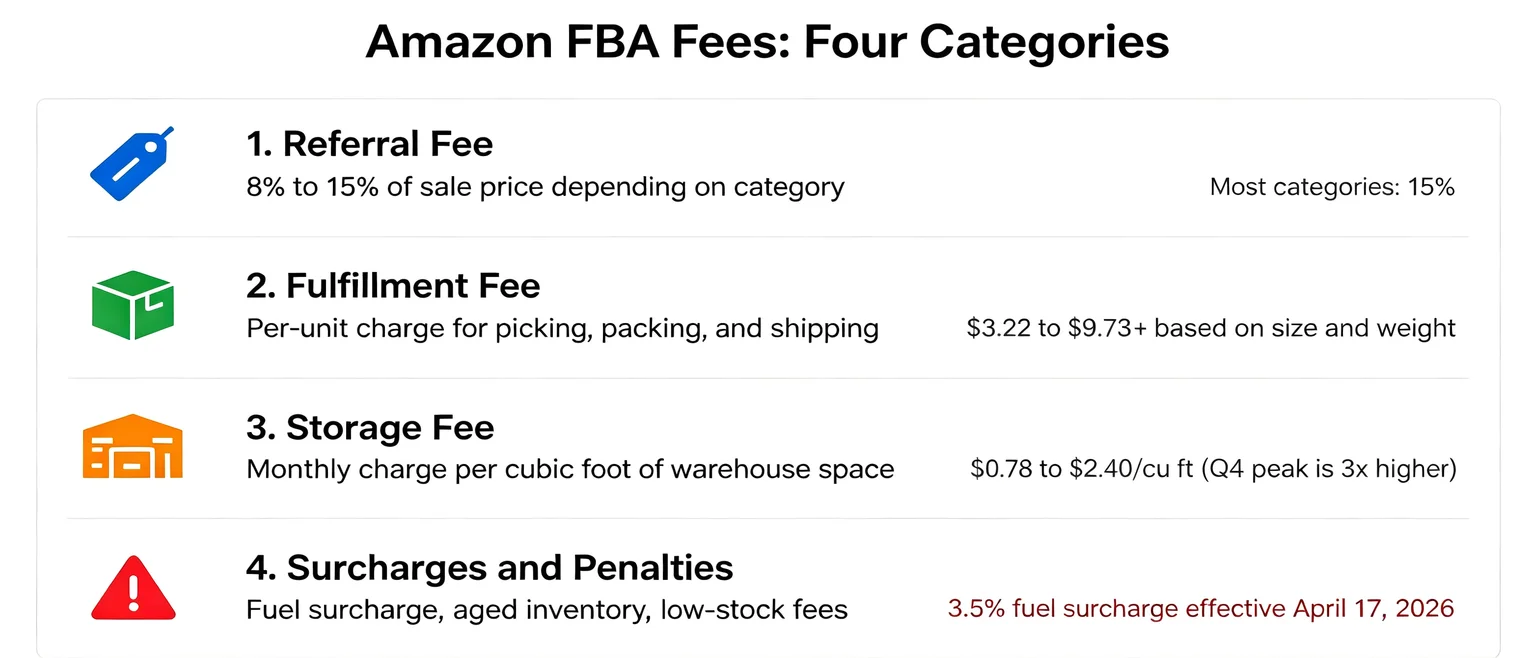
Most FBA sellers calculate two fees: referral and fulfillment. They miss the other five. By the time inbound placement, storage, fuel surcharge, low inventory penalties, and returns processing are included, total Amazon fees consume 30 to 45 percent of selling price on most products before a single dollar of advertising spend.
This is the complete breakdown of every FBA fee in 2026, what changed in January and April, and what the full cost looks like on a real product.
What Changed in 2026 – Two Fee Increases, Not One
Most sellers heard about the January 2026 FBA fee increase. Fewer planned for the April one.
January 15, 2026: Amazon raised FBA fulfillment fees by an average of $0.08 per unit. Standard-size products saw increases of $0.04 to $0.18 per unit depending on size tier. Products priced above $50 saw a disproportionate average increase of $0.31 per unit. Amazon noted this was the first increase since 2024, following no changes in 2025.
April 17, 2026: Amazon introduced a 3.5% fuel surcharge applied to FBA fulfillment fees. This is a percentage on top of the fulfillment fee, not a flat amount. A product with a $4.75 fulfillment fee now pays an additional $0.17 in fuel surcharge per unit.
The two increases stack. A product that paid $4.57 in fulfillment fees in 2025 now pays $4.75 base plus $0.17 fuel surcharge — $4.92 total. That is an 8 percent effective increase on fulfillment alone before any other fee changes are counted.
Referral Fees – The Percentage You Pay on Every Sale
Amazon charges a referral fee on every unit sold. It is calculated as a percentage of the total sale price including any shipping charges collected from the buyer.
Most categories charge 15 percent. Some charge less. A few charge more.
| Category | Referral Fee |
|---|---|
| Most categories | 15% |
| Electronics | 8% |
| Computers | 8% |
| Clothing and accessories | 17% |
| Jewelry | 20% on first $250, 5% above |
| Amazon Device Accessories | 45% |
| Grocery under $15 | 8% |
| Grocery over $15 | 15% |
The referral fee is deducted from your payout before you receive it. It does not appear as a separate line item on your bank statement. Many sellers see the net deposit and never calculate what percentage went to Amazon as commission.
Referral fees did not increase in 2026. They remain unchanged from 2025.
FBA Fulfillment Fees – What Amazon Charges to Pick, Pack, and Ship
The fulfillment fee covers picking, packing, and shipping each unit. It does not cover storage, inbound shipping, returns, or advertising.
Fees are based on size tier and weight. Amazon uses the greater of actual weight or dimensional weight for most size tiers. Enter your product dimensions and weight into the FBA Fee Calculator to see the exact fulfillment fee for your product before committing inventory.
2026 fulfillment fees (non-peak, excluding fuel surcharge):
| Size Tier | Weight | Fee |
|---|---|---|
| Small standard | 2 oz or less | $3.22 |
| Small standard | 2-4 oz | $3.31 |
| Small standard | 4-6 oz | $3.43 |
| Small standard | 6-8 oz | $3.53 |
| Small standard | 8-10 oz | $3.65 |
| Small standard | 10-12 oz | $3.74 |
| Small standard | 12-16 oz | $3.86 |
| Large standard | 6-10 oz | $4.27 |
| Large standard | 10-16 oz | $4.60 |
| Large standard | 1-1.5 lb | $5.04 |
| Large standard | 1.5-2 lb | $5.40 |
| Large standard | 2-2.5 lb | $5.89 |
| Large standard | 2.5-3 lb | $6.27 |
| Large standard | 3+ lb | $6.97 + $0.16 per lb above 3 |
Add 3.5% fuel surcharge to all of the above effective April 17, 2026.
Apparel products pay an additional $0.40 per unit surcharge on top of the standard fulfillment fee.
April 17, 2026 Update: Fuel and Logistics Surcharge
Effective April 17, 2026 Amazon added a 3.5% fuel and logistics surcharge on all FBA fulfillment fees in the US and Canada. The surcharge also applies to Remote Fulfillment with FBA shipping from the US into Canada, Mexico, and Brazil. Buy with Prime and Multi-Channel Fulfillment were included from May 2, 2026.
The surcharge is calculated on the fulfillment fee only, not on the sale price or any other fee category. It does not apply to referral fees, storage fees, inbound placement fees, or any other Amazon charge.
Average per-unit impact: approximately $0.17 for standard-size items. The exact amount depends on your size tier and fulfillment fee. A product with a $5.00 fulfillment fee pays $0.18 in fuel surcharge.
Amazon described the surcharge as temporary but provided no end date. The 2022 fuel surcharge was also described as temporary before being rolled into permanent base fees. Plan for this surcharge to remain in place through at least the end of 2026.
Price tier impact: Products priced above $50 saw higher average fee increases in 2026 than lower-priced products. If you sell a product priced just below $50, review whether a price increase above $50 would still maintain margin after the additional fee impact.
Storage Fees – The Cost of Inventory Sitting in Amazon’s Warehouses
Amazon charges monthly storage fees based on the average daily cubic feet your inventory occupies.
Standard-size storage:
January through September: $0.78 per cubic foot per month
October through December: $2.40 per cubic foot per month
Q4 storage is roughly three times the off-peak rate. Inventory that sits unsold in October, November, and December costs significantly more per cubic foot than the same inventory in July.
Long-term storage:
Inventory stored over 181 days: surcharge applies
Inventory stored over 365 days: $6.90 per cubic foot or $0.15 per unit, whichever is greater
The practical implication: sending excess inventory to FBA for Q4 and failing to sell through creates a compounding cost. You pay 3x storage rates on units you are also paying long-term fees on.
Pull inventory that has not sold in 180 days before October 1 each year. The removal cost is almost always less than the long-term storage fee.
Inbound Placement Fees – The Hidden Cost Most Sellers Overlook
Amazon introduced inbound placement fees in 2024 and expanded them in 2026. This fee covers Amazon’s cost of distributing your inventory across multiple fulfillment centers.
The fee depends on how many fulfillment centers you ship to when sending inventory inbound.
| Shipment Split | Fee per Unit (Standard) |
|---|---|
| Minimal split (1 warehouse) | $0.27 to $1.30 |
| Partial split (2-3 warehouses) | $0.21 to $1.00 |
| Optimized split (4+ warehouses) | $0 to $0.49 |
Most sellers default to minimal split because it is operationally simpler. That convenience costs $0.27 to $1.30 per unit on every inbound shipment. At 1,000 units per month, that is $270 to $1,300 per month in placement fees alone.
The FBA Fee Calculator includes inbound shipping and placement in the full P&L so you see the true cost per unit before sending inventory.
Sellers who use a 3PL to pre-distribute inventory to multiple Amazon fulfillment centers can qualify for optimized split rates and reduce or eliminate placement fees. The 3PL cost needs to be compared against the placement fee savings on a per-unit basis.
Other Fees Sellers Frequently Miss
Fuel surcharge (April 17, 2026): 3.5% of the FBA fulfillment fee on every unit. Already covered above but worth listing separately because it does not appear on most fee estimators that have not been updated since April.
Low inventory level fee: Charged when your historical days of supply on a SKU falls below 28 days. The fee is calculated as a percentage of the FBA fulfillment fee and applies to every unit sold until you restock above the threshold. Sellers who run lean inventory to minimize storage fees can inadvertently trigger this fee.
Returns processing fee: For categories where Amazon offers free returns to buyers, Amazon charges the seller a returns processing fee equal to the fulfillment fee on every returned unit. A product with a $4.75 fulfillment fee that gets returned costs you $4.75 in returns processing on top of losing the sale.
Removal and disposal fees: If you want inventory removed from FBA, Amazon charges per-unit removal fees. Standard-size items run $0.97 to $1.64 per unit. Oversize items are higher.
What the Full Fee Stack Looks Like on a Real Product
Product: kitchen gadget, selling price $29.99, weight 1.5 lbs, Home and Kitchen category.
| Fee | Amount |
|---|---|
| Referral fee (15%) | -$4.50 |
| FBA fulfillment fee (large standard 1.5 lb) | -$5.04 |
| Fuel surcharge (3.5% of $5.04) | -$0.18 |
| Storage (monthly estimate, standard) | -$0.15 |
| Inbound placement (minimal split estimate) | -$0.50 |
| Total Amazon fees | -$10.37 |
| Revenue after Amazon fees | $19.62 |
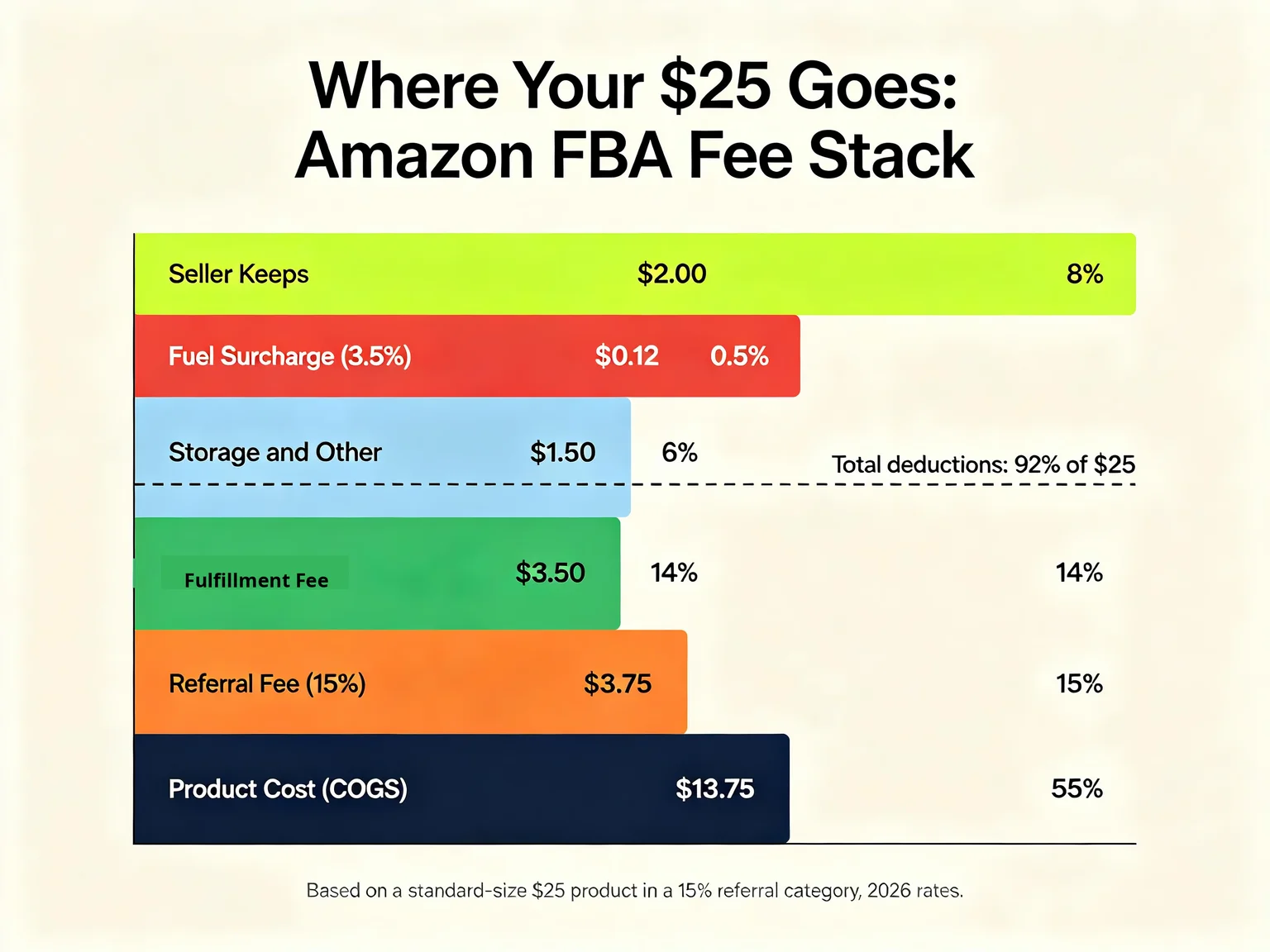
Before COGS, advertising, or inbound shipping cost, Amazon takes $10.37 on a $29.99 sale. That is 34.6 percent of gross revenue.
If COGS is $8.00 and inbound shipping is $0.50, net profit is $11.12 and margin is 37.1 percent. That looks healthy. Add $2.00 in PPC spend and margin drops to 30.4 percent. If the return rate is 10 percent and returns processing costs $5.04 per return, the effective margin on 100 units sold is closer to 27 percent.
This is why the go/no-go decision on FBA profitability requires a full P&L, not just referral plus fulfillment. The FBA Fee Calculator runs the complete calculation including COGS, inbound shipping, PPC, and target margin, and returns a GO, CAUTION, or NO-GO decision before you order inventory.
Rates verified July 22, 2026. See changelog.
You've read the theory—now see the actual math for your packages. Use our Carrier Savings Engine to identify 'Savings Gaps' in your packaging and discover the cheapest way to ship your products.
Check My Savings →FAQ
Q: What are the main Amazon FBA fees in 2026?
A: Amazon FBA fees include referral fees (8-15% of sale price depending on category), fulfillment fees ($3.22 to $6.97+ per unit based on size and weight), a 3.5% fuel surcharge on fulfillment fees effective April 17 2026, monthly storage fees ($0.78 per cubic foot standard, $2.40 in Q4), inbound placement fees ($0 to $1.30 per unit), and conditional fees including low inventory level fees and returns processing. Total fees typically consume 30-45% of selling price.
Q: What changed with Amazon FBA fees in 2026?
A: Two changes took effect in 2026. On January 15, fulfillment fees increased by an average of $0.08 per unit, with products priced above $50 seeing higher average increases of $0.31 per unit. On April 17, Amazon introduced a 3.5% fuel surcharge applied to all FBA fulfillment fees. These changes stack: a product that paid $4.57 in fulfillment fees in 2025 now pays approximately $4.92 after both increases.
Q: How do I calculate my true FBA profit margin?
A: Start with your selling price and subtract all fees: referral fee, fulfillment fee, fuel surcharge, storage estimate, inbound placement, and any PPC spend. Then subtract COGS and inbound shipping cost. The result is net profit. Divide by selling price for margin percentage. The FBA Fee Calculator runs this calculation automatically and returns a GO, CAUTION, or NO-GO decision based on your target margin.
Q: What is the Amazon FBA fuel surcharge in 2026?
A: Amazon introduced a 3.5% fuel surcharge on FBA fulfillment fees effective April 17, 2026. It is applied as a percentage of the base fulfillment fee on every unit sold. A product with a $5.04 fulfillment fee pays an additional $0.18 per unit in fuel surcharge. This surcharge applies to all standard and oversize FBA products and is separate from the January 2026 base fee increases.