How to Calculate DIM Weight – Complete Guide
You put a 3-pound item in a box. The carrier bills you for 9 pounds. No error. No overcharge. That is dimensional weight pricing, and it applies to most packages shipped via UPS, FedEx, and USPS in 2026.
Understanding how DIM weight is calculated is the difference between pricing your shipping accurately and absorbing a cost you did not plan for.
What Is Dimensional Weight?
Dimensional weight, also called DIM weight or volumetric weight, is a calculated weight based on a package’s length, width, and height. Carriers introduced it because trucks and planes run out of space before they run out of weight capacity.
A large lightweight box takes the same trailer space as a dense heavy one. Without DIM pricing, the seller shipping pillows pays far less than the seller shipping machine parts, despite using equal cargo space. DIM weight fixes that.
Every shipment gets two weights: actual weight from a scale, and dimensional weight calculated from volume. The carrier charges whichever is higher. That higher number is your billable weight.
For most e-commerce sellers, DIM weight becomes the billable weight on 20 to 40 percent of shipments. That share increases when you use standardized box sizes with excess void space, because you are paying to ship air.
The DIM Weight Formula

The formula is the same across all major carriers. Only the divisor changes.
Dimensional Weight = (Length × Width × Height) ÷ DIM Divisor
All measurements in inches. Result in pounds. Always round the final DIM weight up to the next whole pound.
Example: A box measuring 14 × 10 × 8 inches.
14 × 10 × 8 = 1,120 cubic inches
1,120 ÷ 139 = 8.06 pounds
Rounded up: 9 pounds DIM weight
If the actual scale weight is 3 pounds, you pay for 9 pounds. The DIM weight is the billable weight because it is higher.
DIM Divisors by Carrier – 2026
The divisor is the number you divide cubic inches by to get DIM weight. A lower divisor produces a higher DIM weight, meaning more packages get billed at DIM pricing rather than actual weight.
| Carrier | Service | DIM Divisor | Applies To |
|---|---|---|---|
| UPS | Ground, Air, International | 139 | All packages |
| FedEx | Ground, Air, International | 139 | All packages |
| USPS | Ground Advantage (retail) | 166 | Packages over 1,728 cu in |
| DHL | Express International | 139 | All packages |
USPS has a threshold that UPS and FedEx do not. USPS only applies DIM weight to packages larger than 1,728 cubic inches. In plain terms: if your box is 12 × 12 × 12 inches or smaller, USPS bills you actual weight only. Larger than that, DIM pricing kicks in.
UPS and FedEx apply DIM weight to every package regardless of size. There is no minimum threshold.
The August 2025 Rounding Rule – The Change Most Sellers Missed
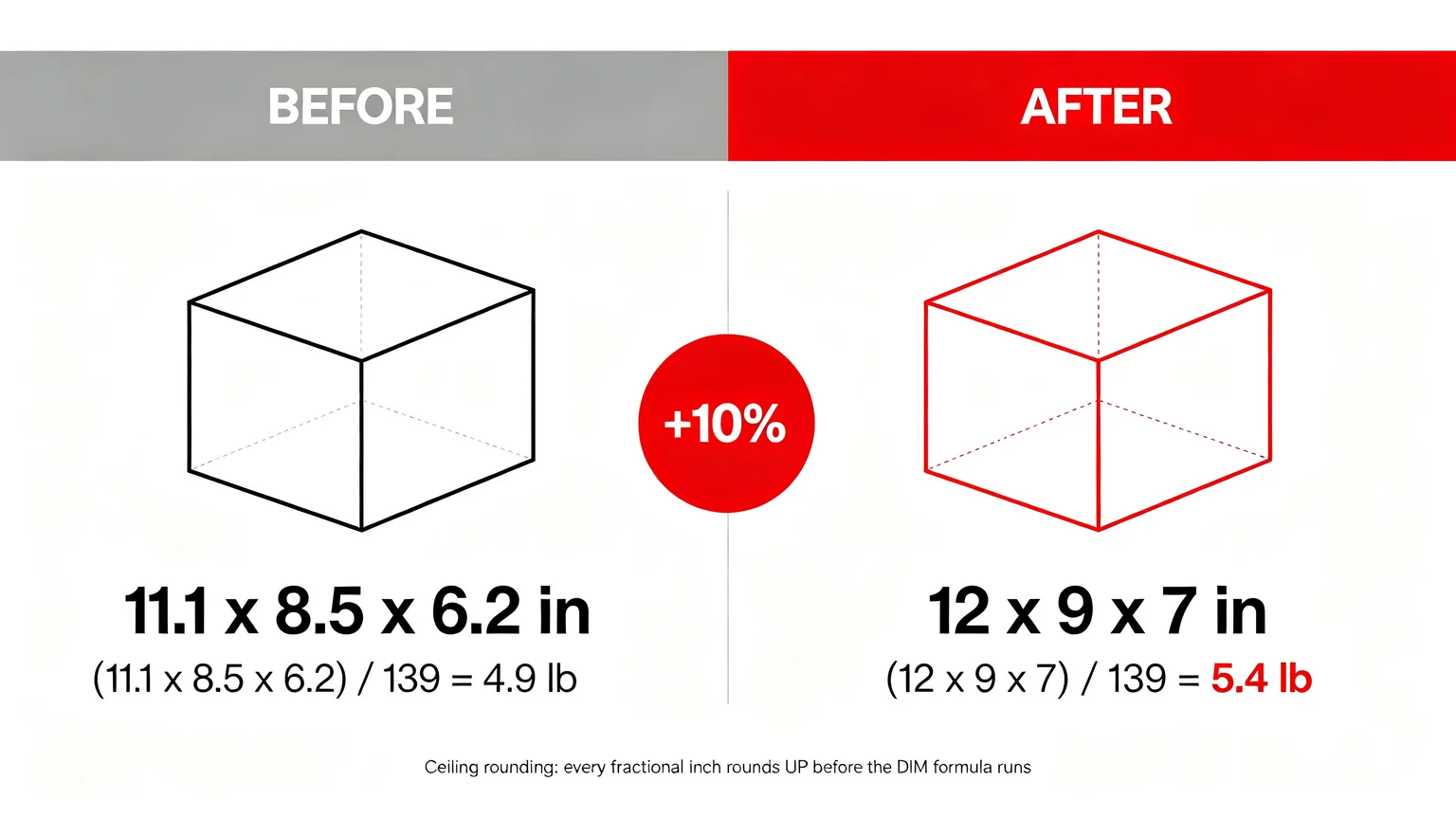
In August 2025, UPS and FedEx introduced ceiling rounding. Every fractional inch in a package dimension now rounds up to the next whole inch before the DIM formula is applied.
Before August 2025: 11.1 × 8.5 × 6.2 inches calculated as 11.1 × 8.5 × 6.2
After August 2025: rounds to 12 × 9 × 7 inches before the formula runs
Old DIM weight: (11.1 × 8.5 × 6.2) ÷ 139 = 4.9 pounds
New DIM weight: (12 × 9 × 7) ÷ 139 = 5.4 pounds
That is a 10 percent increase in billable weight on a box whose physical dimensions did not change by more than an inch on any side. Across 500 shipments a month at $12 per billable pound, that is a material cost increase that hits every month without any visible explanation on your invoice.
USPS does not apply ceiling rounding. DHL applies it to international express shipments.
Sellers who have not re-measured their standard box sizes since August 2025 are likely being systematically overbilled on UPS and FedEx shipments.
How the 4 Carriers Compare on the Same Package
Using the same 14 × 10 × 8 inch box, 3 pound actual weight, shipping to Zone 5:
After ceiling rounding, dimensions stay 14 × 10 × 8 (all whole numbers, no rounding needed).
Cubic inches: 1,120
| Carrier | Divisor | DIM Weight | Billable Weight | Est. Cost Zone 5 |
|---|---|---|---|---|
| UPS Ground | 139 | 9 lb | 9 lb | ~$14.60 |
| FedEx Ground | 139 | 9 lb | 9 lb | ~$16.90 |
| USPS Ground Advantage | 166 | 7 lb | 7 lb | ~$13.20 |
| USPS Cubic | Flat tier | 3 lb | 3 lb | ~$9.20 |
USPS Cubic bypasses DIM pricing entirely for eligible packages. Instead of calculating volumetric weight, it assigns a flat rate based on the cubic tier your package falls into. For a 14 × 10 × 8 box: 1,120 cubic inches = 0.648 cubic feet. That exceeds the 0.5 cubic foot maximum for USPS Cubic, so this package would not qualify.
Shrink the box to 12 × 10 × 8: 960 cubic inches = 0.556 cubic feet. Still over. Try 10 × 10 × 8: 800 cubic inches = 0.463 cubic feet. That qualifies for the 0.5 cubic foot tier at $11.80 Zone 5, which still beats UPS and FedEx Ground.
This is the calculation most sellers never run. The DIM Weight Calculator runs all four carriers simultaneously, checks USPS Cubic eligibility automatically, and shows the cheapest option for your exact dimensions and ZIP code.
What Happens If You Measure Wrong
Carriers run automated dimensioning at their hubs. UPS and FedEx both use in-line dimensioning technology that scans packages as they move through the facility.
If your declared dimensions are lower than the scanned dimensions, the carrier rebills you at the correct weight. You get an adjustment invoice after the fact, often weeks later, with no clear explanation of which shipment triggered it.
The most common measurement errors:
Measuring inside the box instead of outside. Carriers measure the exterior including any bulges or irregular shapes. Always measure the outermost point on each side.
Using fractional measurements and not applying ceiling rounding yourself. If you quote a package as 11.5 × 8.3 × 6.7 inches and the carrier rounds to 12 × 9 × 7, the DIM weight is higher than what you calculated. Build ceiling rounding into your own calculations before printing the label.
Using the wrong divisor. USPS retail Ground Advantage uses 166. If you calculate using 139 and ship via USPS, you are overpaying on labels or underestimating cost.
Rates verified June 19, 2026. See changelog.
You've read the theory—now see the actual math for your packages. Use our Carrier Savings Engine to identify 'Savings Gaps' in your packaging and discover the cheapest way to ship your products.
Check My Savings →FAQ
What is the DIM weight formula?
Dimensional Weight = (Length × Width × Height) ÷ DIM Divisor. Measurements in inches, result in pounds, rounded up to the next whole pound. UPS and FedEx use a divisor of 139. USPS uses 166 for retail Ground Advantage.
Does USPS use dimensional weight?
Yes, but only for packages larger than 1,728 cubic inches. That is roughly a 12 × 12 × 12 inch box. Packages smaller than that threshold are billed at actual weight only. UPS and FedEx apply DIM weight to every package regardless of size.
What is the 2026 DIM weight rounding rule?
UPS and FedEx introduced ceiling rounding in August 2025. Every fractional inch now rounds up to the next whole inch before the DIM formula is applied. A box measuring 11.1 × 8.5 × 6.2 inches is calculated as 12 × 9 × 7. This increases billable DIM weight on most packages with non-whole-number dimensions.
How do I find the cheapest carrier for my package?
Calculate DIM weight for all four carriers on your exact box dimensions using the DIM Weight Calculator. Enter your ZIP code for zone-based pricing. USPS Cubic eligibility is checked automatically and shown if it applies.