UPS vs FedEx DIM Weight – Who Wins by Zone

UPS and FedEx use the same DIM divisor. Same formula. Same ceiling rounding rule. On paper they are identical for dimensional weight calculations. In practice, the cheaper carrier depends on your zone, your package weight, and whether you are shipping to a residential address.
Both carriers implemented a 5.9% General Rate Increase recently. For the full breakdown see our carrier rate increases guide.
This article breaks down where each carrier wins, what changed, and the USPS divisor change hitting July 12 that most sellers have not planned for.
⚠️ USPS is changing its DIM divisor from 166 to 139 on July 12. Details below.
UPS vs FedEx DIM Weight: The Divisor Is the Same
Both UPS and FedEx use a DIM divisor of 139 for domestic ground shipments.
Dimensional Weight = (Length × Width × Height) ÷ 139
The result is identical on any package you put through both formulas. A 14 × 10 × 8 inch box produces 9 pounds DIM weight at UPS and 9 pounds DIM weight at FedEx. The divisor is not where the cost difference comes from.
One caveat: UPS offers a retail divisor of 166 for non-account shippers paying counter rates. If you do not have a UPS account and are paying retail, your DIM weight calculation uses 166, producing a lower DIM weight than FedEx’s universal 139. For sellers with accounts or using a platform like Pirate Ship or ShipStation, the 139 divisor applies at both carriers.
Both carriers introduced ceiling rounding. Every fractional inch rounds up to the next whole inch before the formula runs. A 12.3 inch dimension becomes 13. This applies equally at UPS and FedEx, so it does not change which carrier is cheaper. It does mean both are billing higher DIM weight than they were before.
Where the Cost Difference Actually Comes From
You've read the theory—now see the actual math for your packages. Use our Carrier Savings Engine to see if you can unlock hidden USPS Cubic rates by shrinking your packaging.
Check My Savings →The DIM weight is the same at both carriers. The shipping cost is not.
FedEx Ground and UPS Ground price identically on DIM weight but diverge on base rates, residential surcharges, and zone pricing.
Residential surcharges:
UPS Ground residential: ~$6.00-6.50 per package
FedEx Home Delivery residential: $6.45 per package
FedEx Home Delivery is typically 3-5% cheaper than UPS Ground for residential deliveries in most zones. For commercial addresses, UPS Ground is often competitive or slightly cheaper.
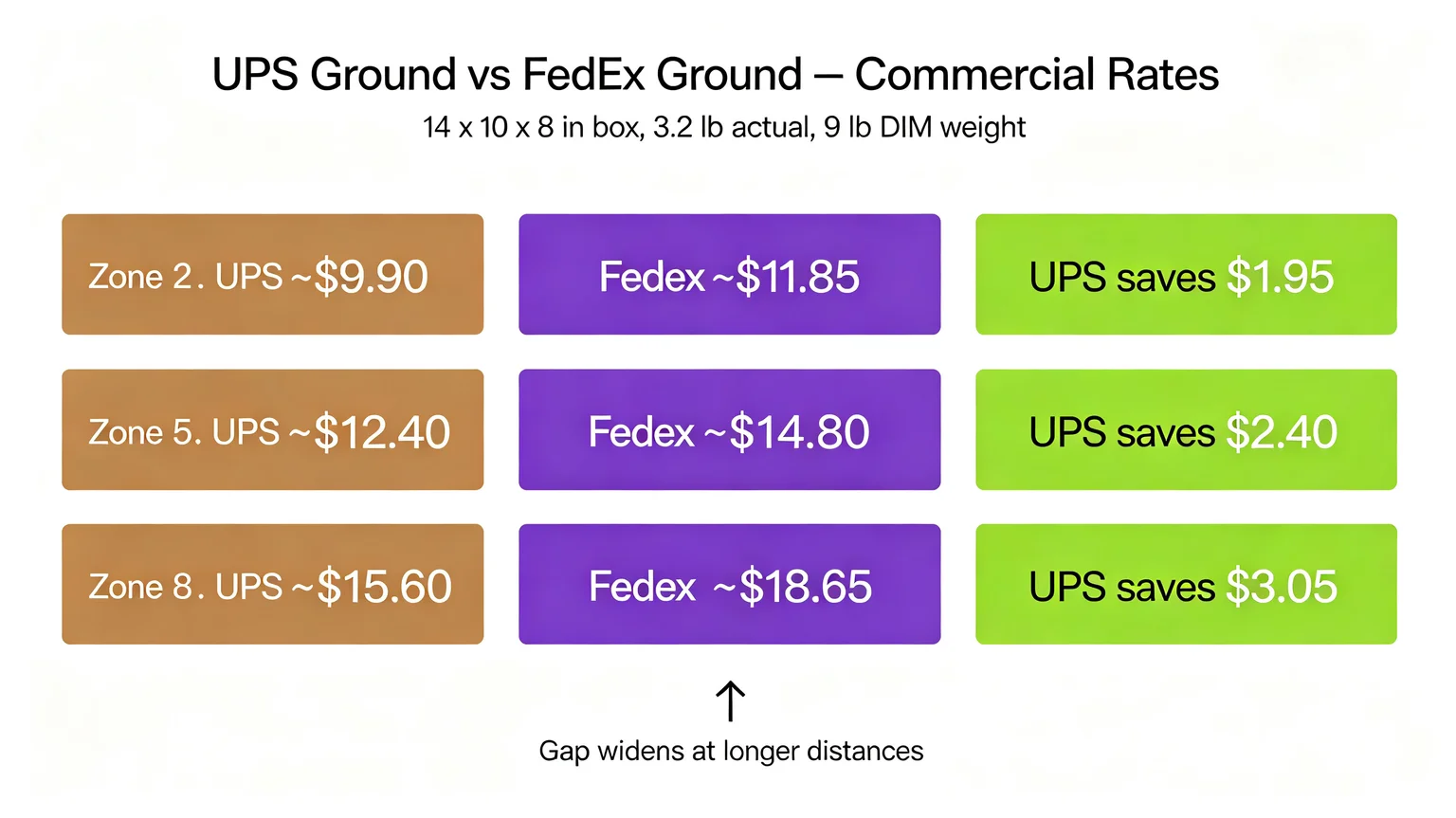
Zone-by-zone Commercial Ground comparison — 14 × 10 × 8 in, 3.2 lb actual, DIM weight 9 lb:
| Zone | UPS Ground | FedEx Ground | Cheaper |
|---|---|---|---|
| Zone 2 | ~$9.90 | ~$11.85 | UPS by $1.95 |
| Zone 5 | ~$12.40 | ~$14.80 | UPS by $2.40 |
| Zone 8 | ~$15.60 | ~$18.65 | UPS by $3.05 |
UPS Ground beats FedEx Ground by $1-3 across most zones on ground shipments when comparing commercial account rates. The gap widens at longer distances.
The USPS Change Hitting July 12 – What Sellers Need to Know
This is the change most competitors are not explaining clearly to e-commerce sellers.
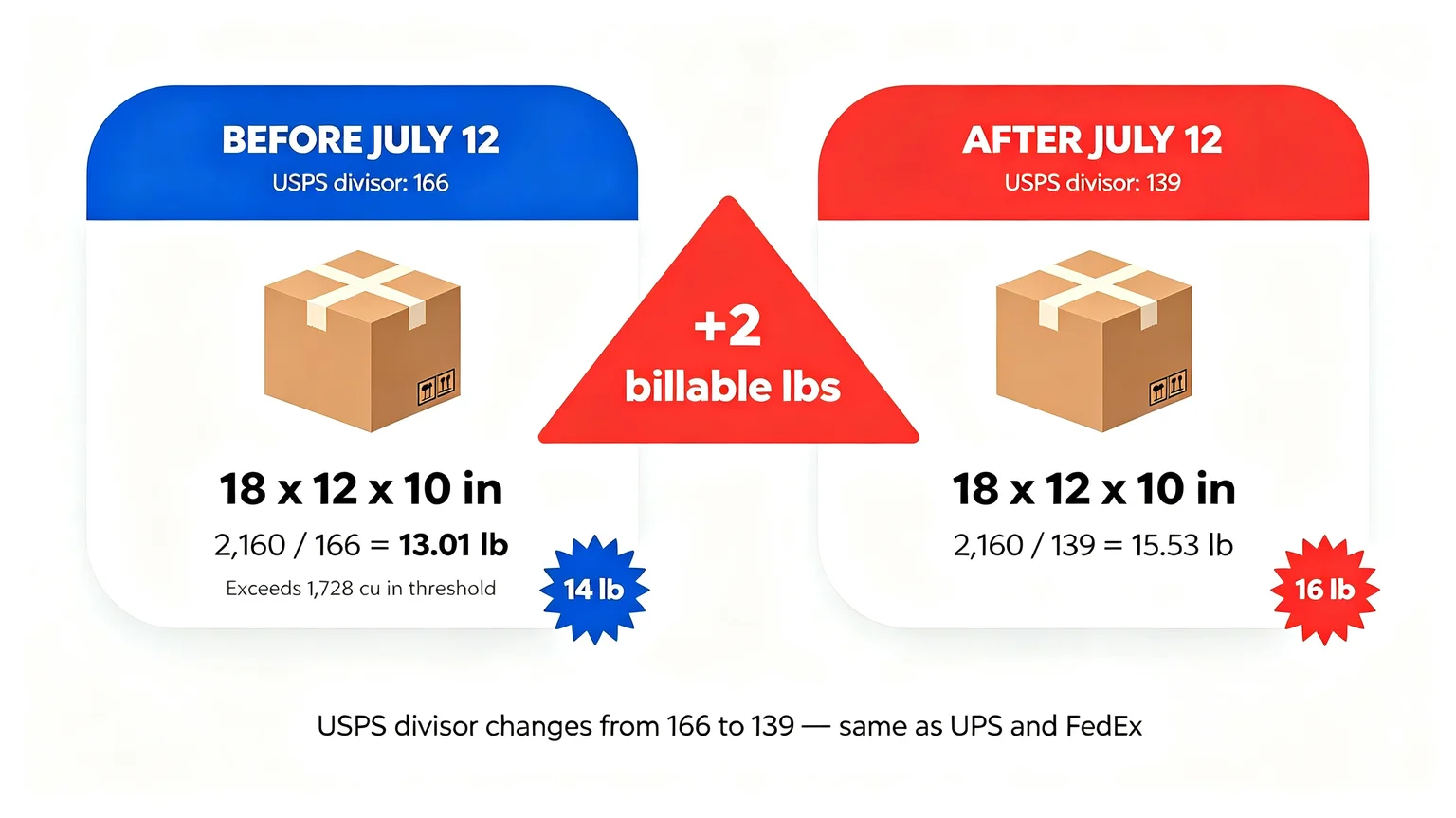
USPS is changing its DIM divisor from 166 to 139 effective July 12. USPS now uses 139 across all package services. The change applies to Ground Advantage, Priority Mail, Priority Mail Express, and Parcel Select for packages exceeding 1,728 cubic inches.
What this means in plain terms: USPS dimensional weight calculations will produce the same result as UPS and FedEx after July 12. The favorable 166 divisor that made USPS cheaper for bulky lightweight packages disappears.
Example: 18 × 12 × 10 inch box, 5 lb actual weight. This box is 2,160 cubic inches, which exceeds the 1,728 cubic inch threshold where USPS DIM pricing applies.
Before July 12: USPS DIM weight = 2,160 ÷ 166 = 13.01 lbs, rounds to 14 lbs
After July 12: USPS DIM weight = 2,160 ÷ 139 = 15.53 lbs, rounds to 16 lbs
That is two extra billable pounds on every package of this size shipped via USPS Ground Advantage after July 12. For sellers who chose USPS specifically because of the 166 divisor, the calculus changes on that date.
USPS Cubic is not affected by this change. Cubic pricing bypasses DIM weight entirely and assigns flat rates by volume tier. For packages that qualify, Cubic remains the cheapest option across all carriers even after July 12.
When UPS Wins vs When FedEx Wins
There is no universal answer. The cheaper carrier depends on your shipment profile.
UPS wins when:
You are shipping to commercial addresses. UPS Ground rates to business addresses are generally more competitive than FedEx Ground in most zones.
You are shipping heavy packages over 10 lbs. UPS rates hold up better at higher weights in ground services.
You are shipping long distance. The UPS vs FedEx gap widens at Zone 7 and Zone 8.
FedEx wins when:
You are shipping to residential addresses in certain zones. FedEx Home Delivery undercuts UPS Ground residential by 3-5% in many cases.
You are shipping lighter packages under 3 lbs where FedEx Ground Economy rates apply.
You have negotiated FedEx volume discounts that bring rates below UPS retail.
Neither wins when USPS Cubic applies. For packages under 0.5 cubic feet, longest side 18 inches or under, and 20 lbs or under, USPS Cubic beats both UPS and FedEx Ground in most zones by $3-6 per package. At Zone 5, USPS Cubic costs around $9.20 versus $12.40 for UPS Ground and $14.80 for FedEx Ground.
Most sellers default to one carrier and never run the comparison. The cost of that default compounds across every order.
How to Find the Cheapest Carrier for Your Exact Package
The only accurate way to compare UPS and FedEx on a specific shipment is to enter the same dimensions, weight, and destination into both carrier rate calculators. That takes four tabs and manual math to include USPS and USPS Cubic.
The DIM Weight Calculator runs all four carriers simultaneously. Enter your dimensions, actual weight, and ZIP code. It maps the ZIP to the correct shipping zone, applies ceiling rounding automatically, checks USPS Cubic eligibility, and highlights the cheapest option with the savings amount shown.
If you are building on the formula from the How to Calculate DIM Weight guide, the carrier comparison is the next step after you have the DIM weight in hand.
See changelog.
FAQ
Do UPS and FedEx use the same DIM divisor?
Yes. Both use a divisor of 139 for domestic ground shipments. UPS offers a retail divisor of 166 for non-account counter shippers. The DIM weight formula produces identical results at both carriers for account holders.
Is UPS or FedEx cheaper for ground shipping?
UPS Ground is typically cheaper than FedEx Ground by $1-3 per package in most zones for commercial addresses. FedEx Home Delivery is 3-5% cheaper than UPS Ground for residential deliveries in some zones. The exact difference depends on weight, zone, and surcharge profile.
What is the USPS DIM divisor change in July?
USPS is changing its DIM divisor from 166 to 139 effective July 12 for packages over 1,728 cubic inches. This eliminates the favorable DIM weight calculation that made USPS cheaper than UPS and FedEx for bulky lightweight packages. USPS Cubic pricing is not affected by this change.
Which carrier is cheapest for small dense packages?
USPS Cubic beats UPS Ground and FedEx Ground for packages under 0.5 cubic feet, longest side 18 inches or under, and 20 lbs or under. At Zone 5, USPS Cubic costs around $9.20 versus $12.40 for UPS Ground and $14.80 for FedEx Ground. Use the DIM Weight Calculator to check eligibility for your exact package.